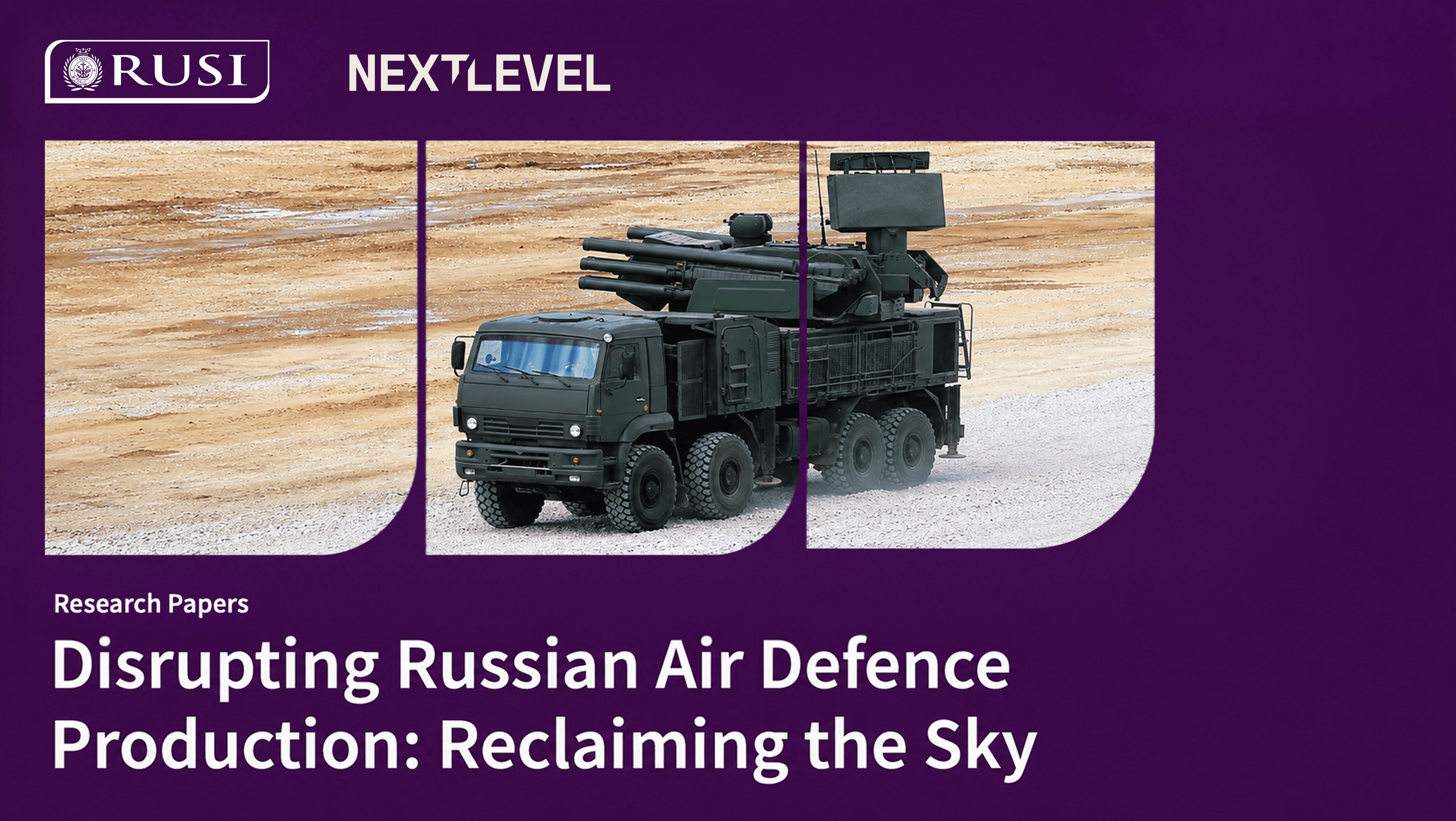
The Royal United Services Institute (RUSI) and Next Level Initiatives, in cooperation with analysts from the Economic Security Council of Ukraine (ESCU), have published the report Disrupting Russian Air Defence Production: Reclaiming the Sky. The researchers analysed the production of Russian air defence systems, primarily the S-400 and Pantsir, and identified their key vulnerabilities.
Russian air defence significantly complicates Ukraine’s long-range strikes and protects Russia’s military and industrial facilities. At the same time, its production depends on foreign components, raw materials, machine tools, testing and measurement equipment, and software.
In 2024, Russia received $42.5 million worth of equipment made by the US company Keysight, including instruments used to test radar systems. Russian production also depends on imported beryllium ceramics used in radar equipment. Russia currently has no operational domestic facilities producing this material and relies on supplies from Kazakhstan.
Russia is already using more interceptor missiles than it produces. Restricting access to critical materials, technologies and equipment could therefore slow the expansion of Russian air defence production and increase the effectiveness of Ukrainian long-range strikes.
Which dependencies remain in the production of the S-400 and Pantsir systems, and how they can be exploited to strengthen sanctions and export controls — in the full report.
Authors:
Dr Jack Watling, Senior Research Fellow for Applied Military Sciences
Nikolay Staykov, RUSI Associate Fellow, Military Sciences
Maya Kalcheva, Analyst at Panoptikon
Olena Yurchenko, Director for Analysis, Investigations and Research at the Economic Security Council of Ukraine (ESCU)
Bohdan Kovalenko, Senior Analyst at ESCU
Olena Zhul, Senior Analyst at ESCU
Oleksii Borovikov, Senior Analyst at ESCU
Anastasiia Opria, Analyst at ESCU
Roman Rabieiev, Analyst at ESCU
Nadiia Reminets, Analyst at ESCU
Alex Whitworth, Independent illustrator and graphic designer