On December 22, 2023, U.S. President Joe Biden signed Executive Order 14114, expanding the powers of the Office of Foreign Assets Control (OFAC). It allows for the imposition of sanctions against foreign financial institutions that serve sanctioned persons and sectors.
Olena Yurchenko, Advisor at the Economic Security Council of Ukraine, pointed out that OFAC can now impose secondary sanctions on foreign banks and financial institutions that:
- Conducted transactions, facilitated activities, or acted on behalf of sanctioned persons in the technology, defense, construction, military-industrial complex, aerospace, or manufacturing industries of Russia.
- Provided services or facilitated any significant transaction related to the Russian military-industrial complex, including the sale, supply, or transfer, directly or indirectly, to the Russian Federation of any item or class of items that may be determined by the Secretary of the Treasury in consultation with the Secretary of State and the Secretary of Commerce.
The goods covered by the transaction blocking include computer numerical control machines, semiconductor manufacturing equipment, testing and measuring equipment, optical systems, navigation devices, and bearings. Responsibility for these actions includes inclusion in secondary sanctions with asset freezes and the prohibition or restriction of correspondent accounts.
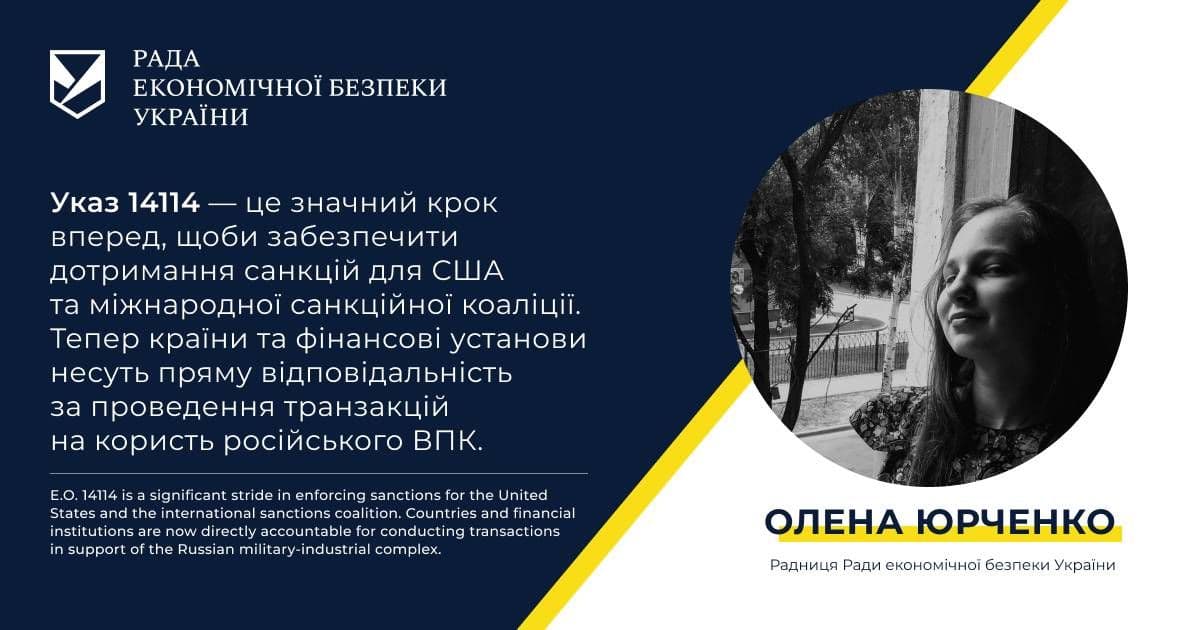
The Executive Order is a significant step forward in ensuring compliance with sanctions for the United States and the international sanctions coalition as a whole. De facto, countries and financial institutions of any level are now directly responsible for transactions in favor of the Russian military-industrial complex, including procurement companies in third countries engaged in sanctions circumvention.
However, the unprecedented nature of the decree creates challenges in implementing its provisions. In particular, the sectoral approach underlying the decree and numerous jurisdictional issues remain unresolved. Equally important, financial institutions have effectively become responsible for implementing commodity restrictions, for which they have little experience. Without being overly optimistic, it remains to be seen how Decree No. 14114 will be implemented and how its provisions will be put into practice.
