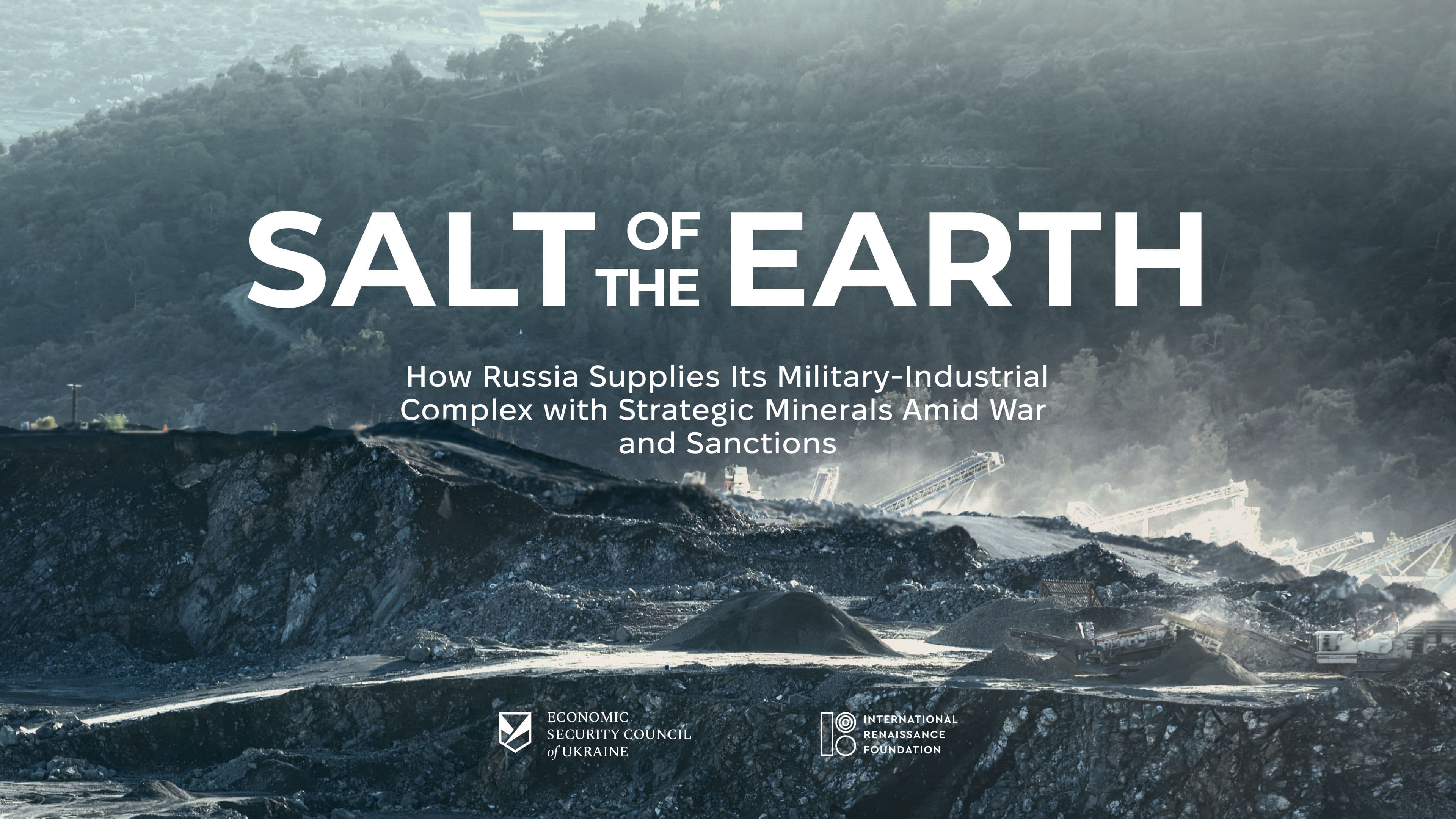
Despite its vast mineral wealth, Russia lacks complete production chains for several strategic minerals needed to sustain its military-industrial complex, according to a new report by the Economic Security Council of Ukraine (ESCU).
Although the Kremlin’s post-2022 plans to expand the extraction of scarce raw materials, ESCU estimates that most projects will not deliver industrial-scale output before 2035, leaving a window for external economic pressure.
China was the dominant supplier across several strategic-mineral chains. Between April 2024 and March 2025, Chinese-origin shipments included 1.6 million metric tons of alumina worth about $1 billion, or 31.5% of Russia’s imports by value; 240 metric tons of tungsten worth $9.8 million, or more than 97%; and 3.8 metric tons of tantalum worth $4.1 million, or just over 30%. China also served as the shipping hub for 1,733 metric tons of niobium products worth $64.1 million, or 58% of Russia’s imports by value.
Brazil supplied Russia with 1,033 metric tons of ferroniobium worth more than $33 million, accounting for about 30% of imports. Canada supplied another 388 metric tons worth $12.8 million, or 11.7%. Russia uses ferroniobium to make high-strength, heat-resistant steels for missile bodies, engines and armored vehicles.
Another 82 metric tons of Dutch-origin ferroniobium worth $2.55 million reached Russia via Turkey, while Germany shipped 40 metric tons of Brazilian- and Canadian-origin material worth $1.22 million. Russia also received 960,35 metric tons of Irish-origin alumina worth $567.68 million from the EU, accounting for 17% of imports. Alumina is used to produce aluminum for military aircraft and missile systems, including the Kh-101, Kalibr and Iskander.
Kazakhstan accounted for nearly 69% of Russia’s tantalum imports by value, worth $9.28 million, and 76% of its beryllium-product imports, worth $11.03 million. Beryllium ceramics are used in radar systems, while the study traces imported tantalum into capacitor supply chains serving companies linked to the Iskander-M, Kinzhal, Pantsir-S and Kh-59 programs.
Uzbekistan supplied Russia with 3.95 metric tons of rhenium feedstock worth $2.3 million, used to produce refractory superalloys for aircraft and missile engines. Belarus supplied another 290 metric tons. Armenia, meanwhile, shipped 2,058 metric tons of molybdenum products worth $65.25 million, or 42% of Russian imports by value. Almost all of that volume was ferromolybdenum, used in specialty steels for the aviation, missile and arm productions.

“Cutting off strategic-mineral supplies would inevitably create weapons shortages in Russia and provide powerful leverage for a ceasefire. That will require decisive economic restrictions across the entire supply ecosystem — from raw materials to traders, exporters and logistics hubs,” said Olena Yurchenko, ESCU’s Director of Analytics, Research and Investigations.
Previous ESCU investigations found that Russia’s military aircraft — including the Su-34 and Su-35S — rely heavily on Chinese tires and Indian fuel additives.
This material was prepared with the support of the International Renaissance Foundation. The material reflects the views of the authors and does not necessarily represent the position of the International Renaissance Foundation.